
For the last few months, I have basically been in a cave.
On the outside it looked like “planner season as usual.” Orders going out. Emails coming in. Social posts. Real life.
On the inside, every spare hour was being poured into one question:
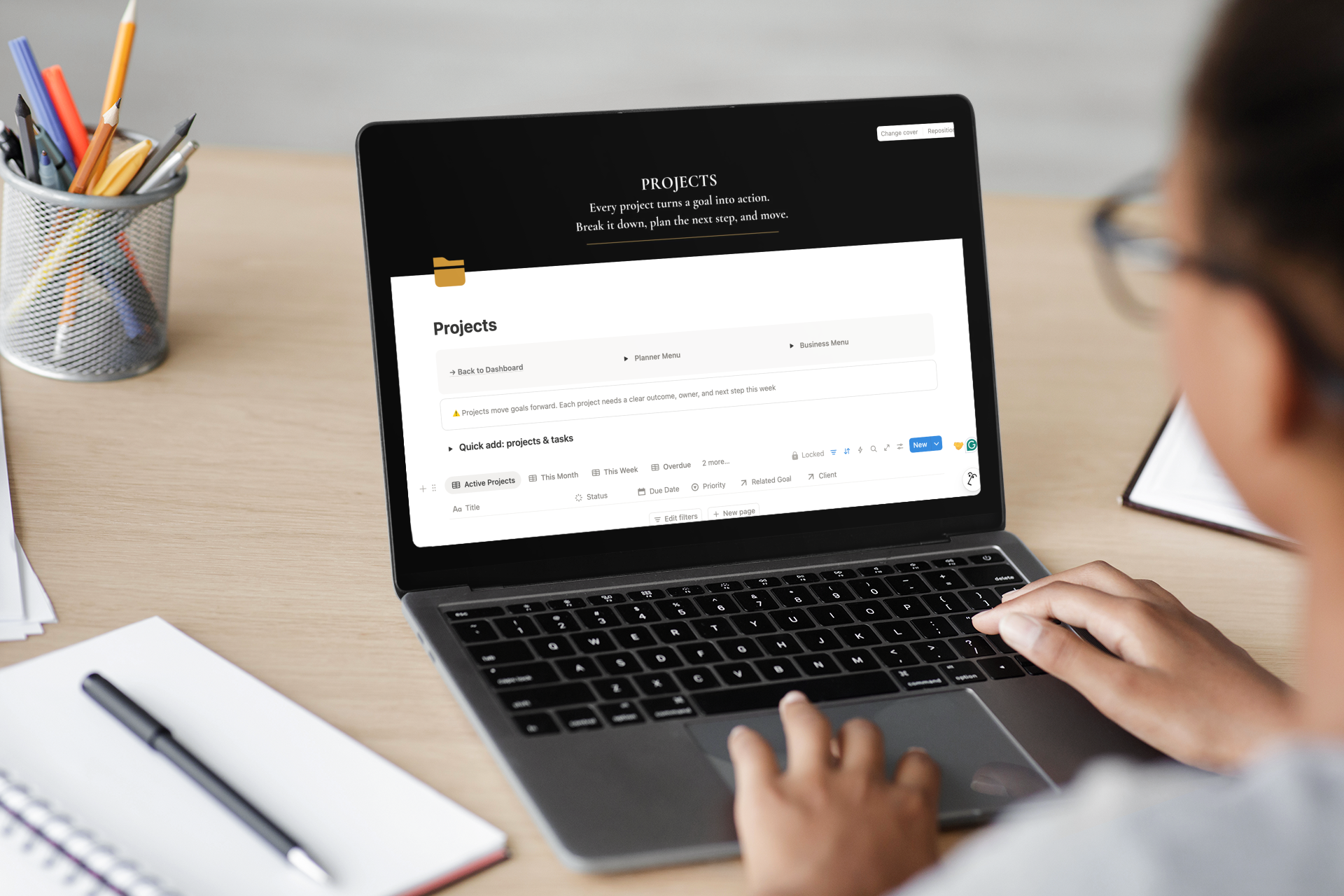
How do I take what MY PA does on paper and turn it into a proper business system that lives in Notion.
I thought it would be simple. A few databases. Some views. A nice dashboard.
It wasn't simple.
At several points I seriously considered walking away from it and pretending I never started.
The idea that would not leave me alone
For years, I have watched customers use the MY PA Planner as their weekly control centre. They plan their goals, block their time, review their weeks and actually move things forward.
But there was always this gap.
They were still running the business in their head. Leads. Client work. Invoices. Content. Ideas. To-dos. All in mental tabs.
I kept thinking, “If only there was one calm place to hold all of this, the way the planner holds their week.”
That idea would not leave me alone. So I decided to build it.
The reality of building in Notion
I started on my own new to Notion , got so far and then thought I can't do this So i handed it over to a Notion developer. That gave me a foundation, but very quickly I realised something important.
If this was going to feel like MY PA, I could not just hand it over and hope. I needed to understand every page. Every property. Every rollup. Every filter.
So I went all in.
I spent evenings and weekends inside Notion, rewiring relationships, fixing formulas, changing layouts, breaking things and starting again.
There were moments where I stared at a database thinking, “I have no idea what I am doing. Who do I think I am building a ‘business system’ for other people?”
More than once, I thought, “Maybe I should just stick to planners and forget this whole thing.”
The messy middle that nobody talks about
We see so many polished launches online. New products appear with a beautiful sales page, perfect screenshots and a confident, “Here you go, it is finally here.”
What we rarely see is the messy middle.
The version that looked good, but did not actually work in real life. The day you realise your logic is wrong and you have to rebuild an entire section. The doubt that creeps in when you are on version nine of something that “should have been done by now.”
There were nights where I closed my laptop convinced that I had ruined the structure. There were other nights where something finally clicked and I could see the whole system working together.
Both were part of the process.
The turning point
The turning point came when I stopped trying to make it clever and started making it kind.
Kind to the tired business owner who opens Notion at 9pm. Kind to the person who is brilliant at their work, but not naturally “systems minded.” Kind to the version of me who has been overwhelmed and overthinking and trying to keep too many plates spinning.
That is when things began to fall into place.
Instead of asking, “What features can I add?” I started asking, “What would make this feel lighter for them on a Tuesday afternoon when everything is on fire?”
That question changed the structure.
What the MY PA Notion Business Hub actually does
The MY PA Notion Business Hub is the result of all of that trial and error.
It is built to sit alongside the 2026 MY PA Planner and act as a calm control centre for the business side of things:
• Your days and weeks under control
• Leads and sales you can actually follow up on
• Client work that does not get lost in email or memory
• Money you can see clearly at a glance, so you are not guessing what has been paid and what is still outstanding
• Content and marketing planned in one place, so you keep showing up consistently
It also has gentle reminders and repeat actions built in, so important things come back when you need them, not at 2am when you are trying to sleep.
And because it lives in Notion, you can use it on desktop, tablet or mobile, which means your business can come with you without taking over your brain.
What I learned from nearly giving up
Looking back, there are a few things this journey taught me that might help if you are building something of your own.
1. The work you secretly wish existed is often worth pursuing The idea that you cannot shake is usually pointing at a real need. The Business Hub started as “I wish my customers had a place to hold all of this.” That whisper turned into a product.
2. Systems are emotional as much as they are logical Yes, there are databases and formulas behind the scenes. But the real work is emotional. It is about reducing anxiety, decision fatigue and mental load. That is what most “productivity systems” forget.
3. You are allowed to ask for help and then learn as you go Starting with a developer was the right move. Finishing it myself was also the right move. You do not have to choose between being “technical” or “not technical.” You can learn on the job if you care enough.
4. There will be a point where you want to throw it all in That does not mean the idea is wrong. It usually means you are in the difficult middle part of the journey where you know enough to see the problems, but not enough to see the full solution yet.
A labour of love
This has been a genuine labour of love.
It is far from a quick template thrown together for a launch. It is months of thinking, testing, breaking, fixing, simplifying and asking, “Would this actually help on a hard day or week?”
If you are in the middle of building your own thing and it feels messy and slow, you are not alone. The polished screenshots never tell the whole story.
And if you are a small business owner who is tired of running everything in your head, I built the MY PA Notion Business Hub for you.
If you would like to take a closer look, you can explore it here: https://www.mypaplanner.com/my-pa-business-hub
Thank you for reading, and if this resonated with you, I’d love to hear where you are in your own “messy middle”.