



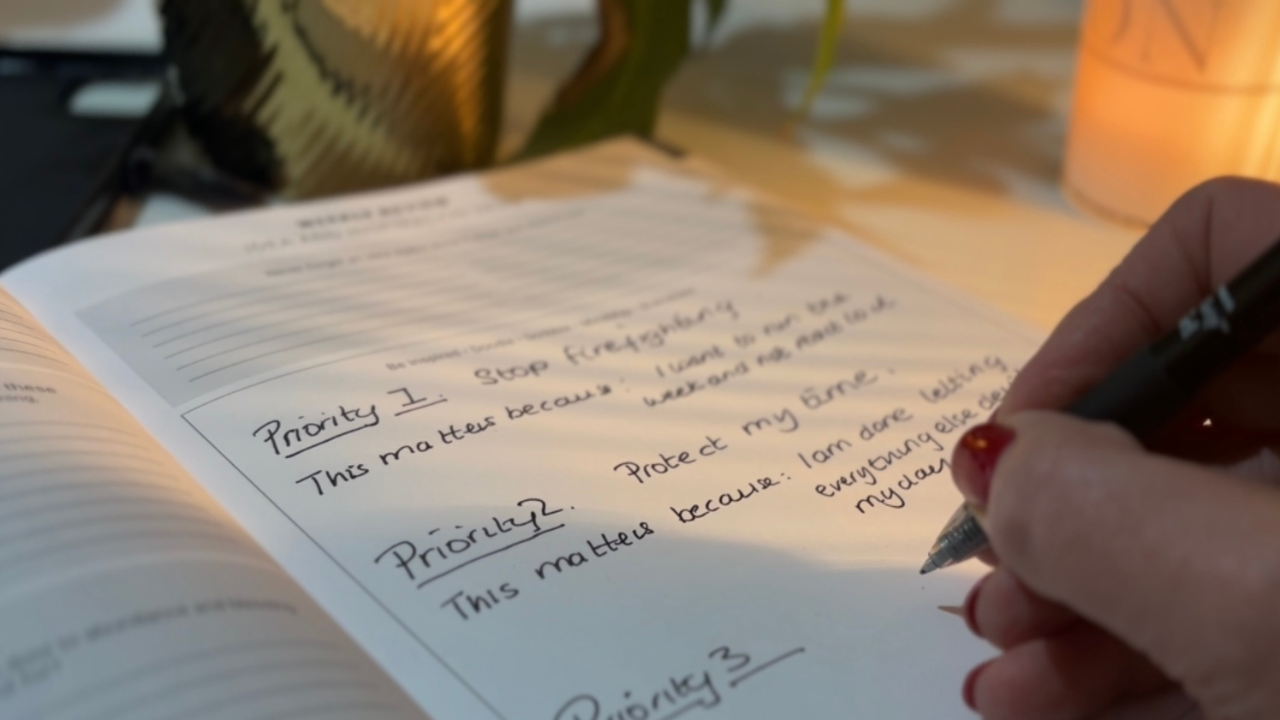
January is supposed to feel like a fresh start.
New goals, new energy, a clear plan for the year ahead.
But for a lot of us, by mid January that plan already feels heavy.
Not inspiring.
Not motivating.
Just pressure.
If that’s you, it’s probably not a discipline problem.
It’s a planning problem.
Why January plans fail so quickly
Most January plans don’t fail because we give up.
They fail because they were built in theory, not in practice.
They look good on paper, but they assume a version of life that doesn’t exist.
Too many priorities. Too many assumptions about how much time we really have. No space for admin, interruptions, thinking time, or recovery.
The plan assumes perfect weeks.
Real life doesn’t work like that.
So by mid January, the plan starts to feel like something we’re constantly behind on, instead of something that helps us move forward.
That’s usually when we start blaming ourselves.
The problem is not effort
When a plan feels heavy, the instinct is to push harder.
Be more disciplined. Be more motivated. Be more consistent.
But most of the time, the issue isn’t effort.
It’s that the plan is trying to do too much at once.
When everything is a priority, nothing really is.
And when every hour is accounted for, there’s no margin for the reality of work, family, messages, delays, or simply needing time to think.
What good planning should actually feel like
A good plan shouldn’t crowd your days.
It should simplify them.
It should give you direction without making you feel like you’re constantly catching up.
Good planning creates:
Clarity on what matters this week
Space for what you didn’t plan for
More realistic expectations about time and energy
It helps you feel in control of your work, not managed by your to do list.
Before you scrap your plan, do this instead
If your January plan already feels heavy, don’t throw it away yet.
That often just leads to starting over, again and again.
Instead, step back and ask:
What am I trying to do that doesn’t actually need to be done right now?
Where have I overestimated how much time or energy I have?
What would this week look like if it only focused on the few things that move things forward?
Often, the fix isn’t more motivation.
It’s fewer priorities.
Planning that fits real life
We don’t need perfect plans. We need plans that fit the way we actually work.
Plans that expect interruptions.
Plans that leave breathing room.
Plans that guide the week, instead of controlling it.
If your January plan feels heavy, that’s not a sign you’re failing.
It’s a sign the plan needs simplifying.
And that’s something we can fix.
So here’s a simple mid January reset you can do in 10 minutes:
Write down everything you think you need to do this week.
Circle the 3 things that actually move the needle.
Pick 1 of those to finish first.
Move everything else into a “Later” list so it stops shouting at you.
Block two small pockets of time this week that are for thinking, not doing.
That’s it.
If the plan feels heavy, we don’t add more.
We remove friction until it becomes workable again.
And we build from there.