


Notion is one of the best tools founders have ever had. It's flexible, powerful, and you can build almost anything inside it.
A lot of small business owners reach the same conclusion once they've been using it for a while: "I should get someone to build me a custom Notion workspace."
It makes sense. You want one place for leads, projects, content, money and planning, all set up properly, so you can stop juggling tools and tabs.
But there's a pattern many founders run into after commissioning a bespoke Notion build. Not that it was badly made. Not that the builder wasn't talented. It's this: the workspace looks impressive, but it slowly stops being used.
Notion becomes another place where information gets stored, instead of the place the business is actually run.

Free Business Planner
Printable weekly layout to plan priorities and stay organised, instant download.
Where Notion Fits for Running a Small Business
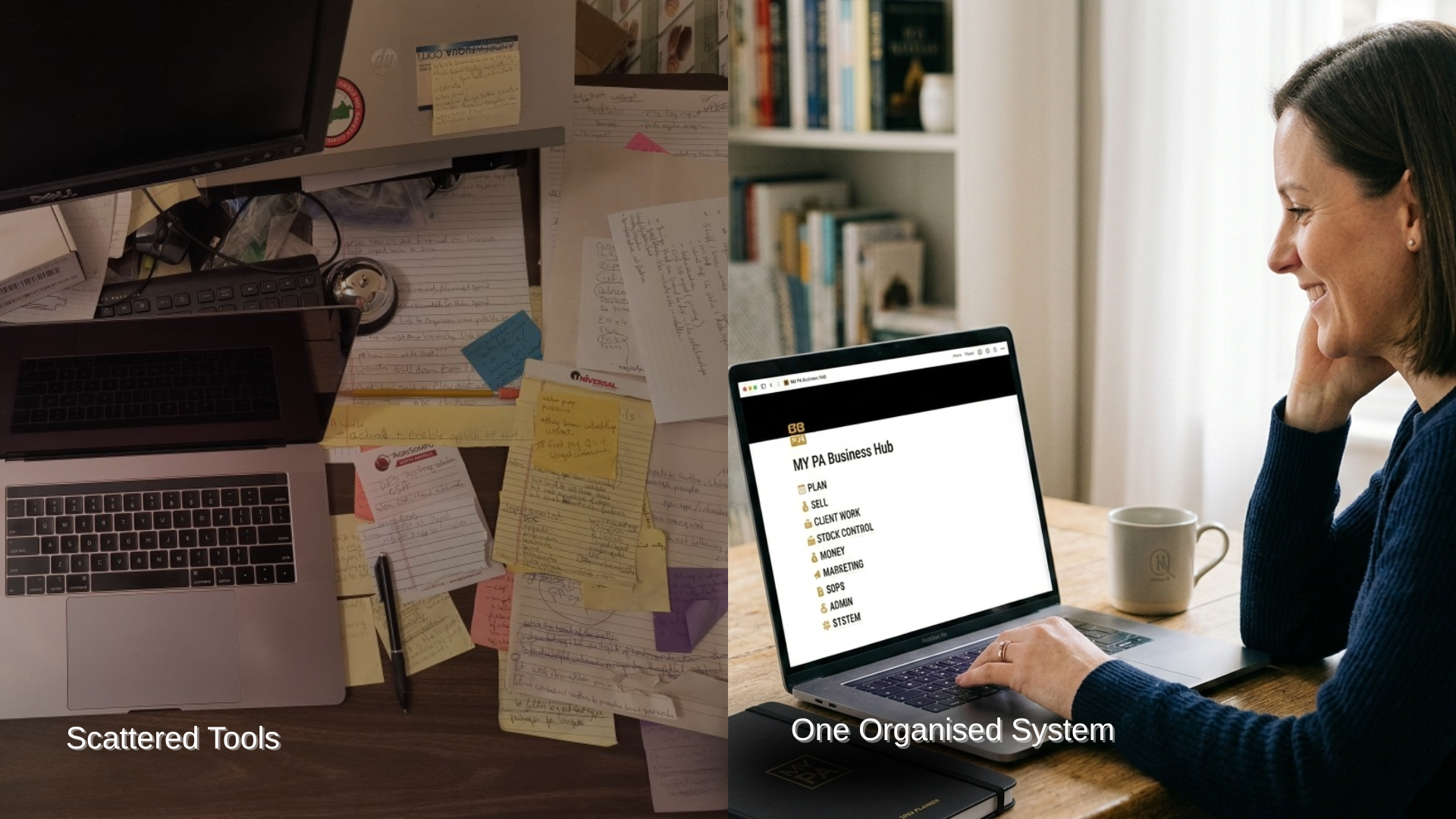
Many founders are now using Notion as a workspace for running their business. Instead of relying on separate tools for CRM, projects, marketing and finance, Notion allows everything to live inside one connected system.
For small businesses, this can be incredibly powerful. A well-structured Notion business workspace can bring together leads, projects, planning, content and money visibility so the entire operation sits in one organised environment. If you're new to the idea, our practical guide to using Notion for business is a good starting point.
But that only works when the workspace is built around how a business actually runs — not just around a collection of databases.
That difference is what determines whether Notion becomes the centre of the business or just another place where information gets stored.
Why Bespoke Notion Builds Often Get Abandoned
Let's be clear. A custom build can be brilliant.
The problem is that many bespoke builds are designed around features, not around how a business operates day to day.
When a workspace is built from scratch, the process typically produces a set of separate "tools" inside Notion. You end up with a CRM database, a projects database, a content calendar, a finance tracker, and a task manager.
None of those are bad. In fact, they are the core parts most businesses need.
The issue is what happens next. In a lot of custom setups, those parts sit next to each other rather than working together as one system. So you end up with five places to put things, but no structure that makes the work flow.
That's where adoption breaks. And when adoption breaks, the system stops being used.
What "Abandoned" Usually Looks Like
It's rarely dramatic. It's subtle.
At first, you use the workspace daily. Then you miss a few days. Then you only open it when you "have time." Then you go back to notes, your inbox, WhatsApp messages, spreadsheets, or whatever you were using before.
If you've ever bought a productivity tool and stopped using it, you already understand the mechanism.
Tools don't fail because the software is weak. They fail because the system doesn't fit how you work, or it's too hard to keep up. This is the same reason running your business across ten different places creates friction — the problem isn't the tools, it's the lack of connection between them.
The Real Issue Isn't the Databases — It's the Structure
This is the important part.
The problem with many custom builds is not that they contain a CRM, projects, content, finance, and tasks. The problem is that they often lack three things that make a workspace usable long-term.
1. Connected workflows
A business is not five separate databases. It's a flow.
Lead becomes client. Client becomes project. Project becomes tasks. Tasks become delivery. Delivery becomes payment.
If your workspace doesn't mirror that flow, you end up duplicating information, copying links, and manually keeping everything aligned. That's the moment the system becomes effort. And once a system feels like effort, founders stop using it.
2. Consistent standards
Most custom builds are built to "look right," but they don't have a consistent operating structure. That means statuses are inconsistent across databases, naming isn't standardised, priorities don't mean the same thing everywhere, views multiply over time, and the workspace becomes cluttered as the business grows.
It starts clean, then slowly becomes messy.
3. A weekly operating rhythm
This is the biggest reason most workspaces don't stick.
Most builds give you places to store information. They don't give you a rhythm for running the business week to week.
Founders don't need more places to put things. They need a repeatable routine that keeps priorities clear and work moving forward. A weekly review is the foundation of that rhythm — without it, Notion becomes passive. You store things in it, but it doesn't drive action.
Founders Don't Need "Custom" — They Need an Operating System
Most founders aren't looking for novelty. They're looking for a way to run their business with less friction.
A real operating system gives you one organised home for the business, connected workflows that reduce duplication, a clear structure that stays clean over time, and a planning rhythm that keeps work moving.
In other words, it doesn't just help you organise. It helps you operate.
That's the difference between a workspace that looks impressive and a workspace that actually runs your business. For a clear breakdown of the systems every business needs, see the 7 business systems every small business needs.
Why a Structured System Beats Starting from Scratch
Custom sounds appealing because it feels like the highest-level solution.
But starting from scratch creates two problems.
First, you're reinventing decisions that don't need to be reinvented. Most businesses need the same operating foundations — the same core structure for organising a small business.
Second, you risk building something that is technically correct but behaviourally wrong. If it doesn't match how founders actually work, it won't stick.
A proven structure solves both. You start with a system designed around real workflows, then adapt it to your business.
Introducing the MY PA Business Hub
This is exactly why the MY PA Business Hub exists.
The Hub is not a set of disconnected templates. It's a structured operating system built in Notion, designed around how a business actually runs.
Yes, it includes the essentials: leads and sales pipeline, projects and delivery, marketing and content planning, finance tracking including invoices and payments, offers and revenue streams, brand messaging and resources, and weekly and monthly planning and reviews.
But here's the crucial difference. It's not just that these sections exist. It's that they're designed to work together — as one workspace, with one operating rhythm.
For a deeper look at what's inside, see our guide to the best Notion business templates. And for the story behind how the Hub was built, read from planner pages to a full business system in Notion.
Next Step
If you are currently considering a custom Notion build, the smartest first move is to look at a proven operating system before you spend money building from scratch.
Explore the MY PA Business HQ and see what a structured workspace looks like when it's designed to actually run a business.
Not sure if you need the full Hub? The MY PA Notion Planner gives you the planning and goal-setting side without the full business operating features — a lighter starting point you can always upgrade from.
Or if you're just getting started, download a free sample of the MY PA Planner to see the planning system that the Notion version is built on. Browse all our free business resources for more templates and guides.
Start your business without guessing
The Business Starter Kit gives you the plan, the pricing, and one place to run it, so you always know what to do next.
- Clear plan, step by step from idea to launch.
- Price for profit, know what to charge and what you will make.
- One Business HQ, run your entire business from one place from day one.
Start free, then choose the next step when you are ready.