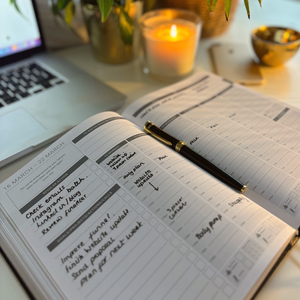



It is 9am. You have thirty things in your head: the invoice you have not sent, the post you meant to write, the client who needs an answer, the supplier email, the idea from last night that you are afraid of forgetting.
You sit down to start, and you cannot decide where to begin. So you check your inbox instead.
If that is familiar, nothing is wrong with you. What you are feeling has a name, and a large part of it is explained by how the brain handles information.
The short answer: overwhelm happens when you ask your working memory to hold more than it can, while switching between tasks and carrying unfinished business around in your head. Stress then makes the part of your brain that plans and prioritises work less well, so it feels even worse. Getting things out of your head and into a plan is the fix that research supports.
In your head vs on the page
| In your head | On the page |
|---|---|
| Everything is "live" at once | Everything is captured and parked |
| Competes for a workspace of about four things | Takes up no mental space |
| Unfinished tasks keep nagging | A specific plan quiets them |
| You decide what to do next while stressed | You decided calmly, in advance |
| Context lost every time you switch | Easy to pick up where you left off |
What overwhelm actually is
Overwhelm is not the same as being busy. Plenty of people are busy and feel fine.
Overwhelm is the feeling that the demands in front of you have outgrown your ability to hold them all at once. It is a mental capacity problem before it is a time problem. That is why you can feel overwhelmed on a day when, on paper, you have plenty of hours.
Why it hits business owners harder
In a job, someone else usually decides what matters this week. In your own business, nobody does. Every decision lands on you: marketing, finances, clients, admin, strategy, and the dozens of small things between them.
There is also no natural finish line. There is always one more thing you could do. So your head becomes the place where the whole business is stored, and that is where the trouble starts.
Your working memory is smaller than you think
Working memory is the mental workspace where you hold things while you think about them. It is small. Research by the psychologist Nelson Cowan suggests it holds roughly four chunks of information at a time, rather than the seven you may have heard about. Scientists still debate the exact number, but they agree it is limited.
Now count what you are trying to hold: deadlines, client requests, ideas, worries, next steps. It is far more than four. When you try to keep all of it in your head, the workspace overflows, and that overflow is the feeling of overwhelm.
You cannot really do two things at once
Most of us believe we can multitask. For anything that takes real effort, the evidence says we are switching, not multitasking.
Research on task switching found that the brain has to do two things each time you change tasks: decide to switch, then turn off the rules of the old task and turn on the rules of the new one. That takes time and effort every single time.
Gloria Mark, who studies attention at the University of California, Irvine, has found that after an interruption it takes about 25 minutes on average to get back to the original piece of work. That figure includes time spent on other things in between, so it is not 25 minutes of staring at a screen. But it shows how quickly a day fragments when you are pulled in different directions.
Heavy media multitaskers have also been found to perform worse on tests of attention and memory. The researchers are careful to say this is an association, and that it is too early to say multitasking is the cause. The practical point still stands: trying to do everything at once is not a skill that makes you better at it.
Unfinished things keep nagging at you
You know the feeling of a task sitting at the back of your mind. Psychologists have studied this for a century.
In a well-known set of experiments, E.J. Masicampo and Roy Baumeister found that unfinished goals kept intruding on people's thoughts, even while they were doing something unrelated, and made them perform worse on other tasks.
Then came the useful part. When people made a specific plan for those goals, the interference disappeared. They did not have to finish the task. They only had to decide when and how they would do it. As the lead researcher put it, you can offload a goal by making a specific plan, and it stops taking up mental space.
This is the single most important finding in this post for business owners. The nagging is not caused by having a lot to do. It is caused by having a lot to do with no plan for it.
Then stress makes it worse
When you are overwhelmed, you get stressed. And stress affects the exact part of the brain you need to get out of it.
Amy Arnsten at Yale, who studies the prefrontal cortex, has shown that even mild uncontrollable stress can quickly weaken the abilities of this region, which handles planning, working memory and flexible thinking. Longer exposure to stress can change its structure.
So you get a loop. Too much in your head causes stress. Stress weakens the part of your brain that sorts and prioritises. Sorting becomes harder, so there is even more in your head. This is why overwhelm feels like it feeds itself, and why "just try harder" does not work.
Technology made it better and worse
Tools have given business owners abilities that used to need a whole team. You can run a shop, a newsletter and a social calendar from one laptop.
They have also multiplied the inputs. Email, messages, notifications, tabs and dashboards all compete for your attention, and every one of them is a prompt to switch. In one workplace study, Mark's team cut people off from email for a week, and they were less stressed and able to focus for longer.
More capability and more noise arrived together. The tools are not going away, so the answer is not to avoid them. It is to give your brain somewhere other than your head to keep track of everything they produce.
Why I built the planner
Overwhelm is the reason MY PA Planner exists. I built the planner because I was running a business, carrying all of it in my head, and could feel how much that was costing me.
Looking back, the research above describes exactly what the planner was doing for me. It gave everything somewhere to live that was not my head.
What actually helps
The research points in one direction: stop using your head as storage, and make a plan for what is in it. Here is how to put that into practice:
Do a brain dump. Write down everything that is in your head, without sorting it.
Make a specific plan for each important thing. Not "do marketing" but what you will do and when. This is the step the research says quiets the nagging.
Choose three priorities for the week. Not the most urgent, the most important. Everything else is captured and can wait. The Daily Top 3 Method shows you how to pick them.
Work on one thing at a time. Protect a block of time for each priority and keep your inbox closed while you do it. Our guide to time blocking walks you through it.
Review weekly and monthly. A short review catches the build-up early, before it turns into overwhelm.
For the weekly habit, read How to Do a Weekly Review as a Business Owner and How to Implement a Consistent Weekly Review Process.
Plan it, and let your head rest
The MY PA 2027 Business Planner is built for this. It gives you one place for your goals, your weekly priorities, your daily schedule and your monthly review, so you can run your business and your life together without holding it all in your head.
Get the free 2027 planner and start getting it out of your head today.
Sources
Cowan, N. (2001). The magical number 4 in short-term memory. Behavioral and Brain Sciences.
Mark, G. and colleagues, research on interruptions and attention, University of California, Irvine.
Ophir, E., Nass, C. and Wagner, A.D. (2009). Cognitive control in media multitaskers. PNAS.