


You've probably bought planners before. Maybe several. They started out well — fresh pages, good intentions, the satisfying feeling of writing out your first week and thinking this time it might finally click. Then somewhere around week two, the planner started living under a pile of papers, at the bottom of your bag, or unopened on your desk while life carried on around it. Every time you saw it, it felt like proof that you had failed again.
That cycle is exhausting, and for a lot of people with ADHD, it feels painfully familiar. But this is not a failure of willpower, discipline, or motivation. It is usually a mismatch between how most planners are designed and how ADHD brains actually work.
A lot of traditional planners expect you to be consistent in ways that are already hard when you have ADHD. They assume you will remember to open them, know exactly where to start, break tasks down clearly, estimate time realistically, and return to the system every day without resistance. That is a big ask.
When a planner depends on high executive function to be used properly, it often becomes another thing that creates pressure instead of support.
The good news is that planning can work with ADHD. It just has to work differently. The goal is not to become the kind of person who uses every section perfectly. The goal is to use a planner in a way that reduces friction, supports your attention, and makes it easier to begin again whenever life gets messy. But do planners actually help with ADHD? The evidence says yes — when the right approach is used.
Why Most Planners Fail ADHD Users
Most planners are built around the idea of consistency. They assume you will plan ahead, follow a routine, and keep everything neatly updated. But ADHD affects the exact skills that most planning systems rely on — things like starting tasks, prioritising, estimating time, switching attention, and following through.
That means the more complicated a planner is, the more likely it is to fail.
If you open a planner and are faced with multiple boxes, habit trackers, sections, prompts, and decisions before you have even written down your first task, it can feel overwhelming straight away. Instead of creating clarity, it creates friction. Instead of helping you start, it gives you another reason to avoid starting.
Many people with ADHD do not abandon planners because they do not care. They abandon them because the planner quietly becomes one more system they feel they are getting wrong.
The planners that tend to work better for ADHD brains have a few things in common. They are simple. They are visually clear. They do not punish inconsistency. They help reduce decisions rather than create more of them. Most importantly, they make re-entry easy. If you miss a day, or a week, you should be able to open the planner and carry on without feeling like the system is broken.
Practical Strategies That Actually Work
Start with the weekly view only
One of the biggest mistakes people make is trying to use every part of a planner straight away. That sounds productive, but it usually creates too much pressure too early.
Start with one section only — the weekly view. Open to the current week, write down your top three priorities, and stop there. Do not force yourself to fill every box or map out your entire life. You are not trying to prove that you can use the planner perfectly. You are building trust with the system.
For many ADHD users, success comes from making the starting point so simple that there is very little resistance.
Keep it visible
This matters more than people think. If your planner is in a drawer, inside a bag, or stacked under other things, there is a good chance it will disappear from your mind entirely.
With ADHD, out of sight often really does mean out of mind.
Keep your planner open on your desk, kitchen table, or wherever you naturally land during the day. The easier it is to see, the easier it is to return to. Visibility acts as a cue. It reduces the mental effort needed to remember that your planner exists in the first place.
Use time blocking instead of loose to-do lists
A long to-do list can look productive, but for many ADHD brains it is too vague to be useful. It tells you what needs doing, but not when to do it. That leaves too much room for procrastination, avoidance, or bouncing between tasks.
Time blocking gives your day more structure. Instead of writing a list, assign each task a place in the day. Even a rough plan is better than none. It turns intention into something more concrete and helps reduce the mental load of deciding what to do next.
ADHD often makes transitions difficult. Time blocking can help because the decision has already been made. Struggling to get started at all? Try our free guide to beating procrastination.
Make the system forgiving
This is one of the most important mindset shifts. If you miss a few days, nothing has gone wrong. You have not ruined the planner. You have not failed the system. You just need to open it again.
A planner that only works when you use it perfectly is not an ADHD-friendly planner.
The best systems are the ones that let you come back without shame. No catching up. No rewriting missed pages. No pressure to make it look neat. Just turn to today, or this week, and start again from where you are.
That ability to reset quickly is what makes a planner sustainable.
Use the weekly review as a reset, not a guilt trip
A weekly review can be incredibly helpful for ADHD, but only if it feels supportive.
Too many review prompts feel like a performance audit. What did you fail to do. Why did you fall behind. What is still unfinished. That kind of reflection can trigger shame, which makes it less likely that someone will return to the planner next week.
A better review asks gentler, more useful questions. What worked well this week. What felt harder than expected. What needs to move into next week. What would make the coming week easier.
That kind of reflection helps you learn from your patterns without turning the planner into evidence against yourself.
What to Look for in an ADHD-Friendly Planner
If you are trying to find a planner that actually works with ADHD, look for one that has clean pages, clear structure, and as little friction as possible.
Good ADHD-friendly planners tend to include one clear purpose per page, simple layouts without visual clutter, built-in time blocking, easy navigation, a forgiving structure that works even if you miss days, and weekly reviews that help you reset rather than criticise yourself.
What matters most is not how many features a planner has. It is whether the planner helps you begin, helps you return, and helps you keep going without overwhelm.
A Planner Should Support You, Not Test You
The right planner should not feel like homework. It should not feel like another thing you are failing to keep up with. It should give your brain a place to land.
That means less pressure, less clutter, fewer decisions, and more structure where it actually counts.
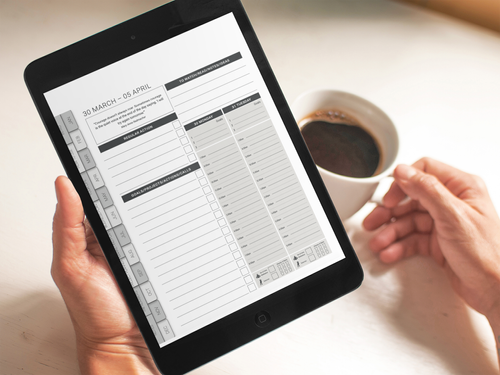
The MY PA ADHD Digital Planner was built around these principles. It includes clean pages with one purpose each, time blocking in every weekly spread, and a gentle weekly review designed to help you reset rather than judge yourself. It is available for iPad, Kindle Scribe, and Remarkable, so you can choose the format that suits the way you think and plan best.
Not sure which device? See our guide to the best ADHD digital planner by device. And explore all our ADHD planning articles for more.