Black Friday starts Sunday, November 22.
Sign up for early access to Black Friday
Free US shipping on orders over $80.

How to Build a Simple Weekly Planning Ritual for 2027

How to Build a Simple Weekly Planning Ritual for 2027

A successful year does not come from big goals or perfect motivation. It comes from the small weekly decisions you make, week after week. The truth is simple: when your week is organised, your business feels lighter, clearer and more manageable. A weekly planning ritual gives you structure without pressure. It creates a rhythm that keeps you focused and removes the feeling of constantly catching up. Here is how to build a simple weekly planning ritual that will support you throughout 2027.

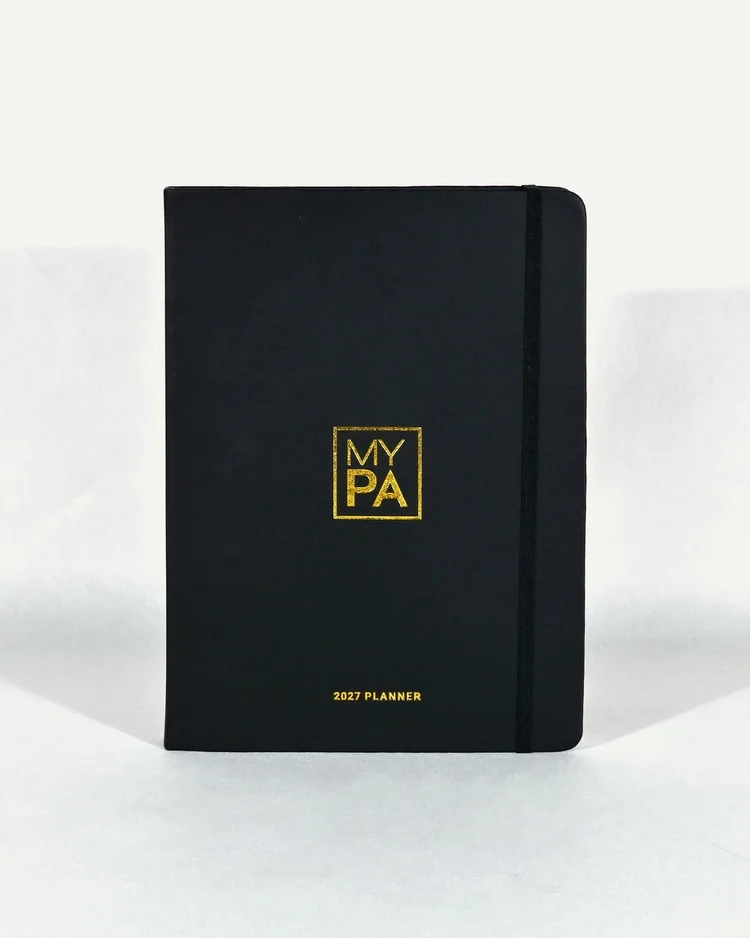
The MY PA 2027 Business Planner in black

As featured in Wired, The Independent and Marie Claire

Make 2027 your most productive year.

The 2027 MY PA Business Planner.
£39 UK · $49 US

Not ready? Get the free 2027 planner

The 2027 Reset Guide: How to Close 2026 Strong and Build a Better Year

The 2027 Reset Guide: How to Close 2026 Strong and Build a Better Year

The end of the year can feel heavy for many business owners. You look back at everything you wanted to do, everything you pushed aside and the goals that are still waiting for you. It is easy to feel frustrated or behind, especially if the year felt messy or chaotic. A proper year end reset gives you clarity, confidence and a clean slate. You can close 2026 in a calm, intentional way and step into 2027 with focus instead of pressure. Here is a simple reset guide to help you finish strong and build a better year ahead.

The MY PA 2027 Business Planner in black

As featured in Wired, The Independent and Marie Claire

Make 2027 your most productive year.

The 2027 MY PA Business Planner.
£39 UK · $49 US

Not ready? Get the free 2027 planner

10 Mistakes Entrepreneurs Make When Planning Their Year (and How to Avoid Them in 2027)

10 Mistakes Entrepreneurs Make When Planning Their Year (and How to Avoid Them in 2027)

Most entrepreneurs do not struggle because they are lazy or unmotivated. They struggle because they are overwhelmed, carrying everything in their head and reacting to whatever comes in. When planning your year, the smallest mistakes create the biggest stress later. If you want 2027 to feel more organised, calm and consistent, here are the 10 common planning mistakes and how to avoid them.

The MY PA 2027 Business Planner in black

As featured in Wired, The Independent and Marie Claire

Make 2027 your most productive year.

The 2027 MY PA Business Planner.
£39 UK · $49 US

Not ready? Get the free 2027 planner

Why Most Planners Fail and How to Choose One That Actually Helps You Grow Your Business in 2027

Why Most Planners Fail and How to Choose One That Actually Helps You Grow Your Business in 2027

Most planners look beautiful, but they do very little to actually support a real business. They are full of empty boxes, aesthetic quotes and clean layouts, but when you sit down to plan your week, they feel useless. Nothing connects. Nothing lines up. You end up writing the same to-do lists every day and still feeling behind.

This is why most people stop using their planner by February.

If you want 2027 to feel more structured, more productive and more stable, the problem is not you. The problem is the planner.

The MY PA 2027 Business Planner in black

As featured in Wired, The Independent and Marie Claire

Make 2027 your most productive year.

The 2027 MY PA Business Planner.
£39 UK · $49 US

Not ready? Get the free 2027 planner

The Ultimate 2027 Business Planning Checklist

The Ultimate 2027 Business Planning Checklist

Planning your business year should not feel overwhelming. It should feel clear, calm and organised, with a simple structure that makes every month easier. Most business owners try to plan everything in their head and end up feeling behind before the year even begins. This 2027 Business Planning Checklist gives you a step by step way to prepare for the year ahead so you can stay focused, protect your time and move your business forward with confidence. Use this checklist as your starting point for 2027, then repeat it every month and week to stay on track.

The MY PA 2027 Business Planner in black

As featured in Wired, The Independent and Marie Claire

Make 2027 your most productive year.

The 2027 MY PA Business Planner.
£39 UK · $49 US

Not ready? Get the free 2027 planner

How to Plan Your Business Year in 2027: A Step-by-Step Guide

How to Plan Your Business Year in 2027: A Step-by-Step Guide

Planning your business year is one of the most powerful things you can do to protect your time, your energy, and your income. Most business owners carry everything in their head, react to whatever comes in, and hope it somehow works out. It rarely does.

2027 can be different. With a clear structure and a simple planning rhythm, you can create a year that feels focused, steady, and profitable rather than chaotic and exhausting.

This guide walks you through the exact steps to plan your business year properly for 2027, using a system that works month after month.

1. Start with your 2026 review

Before you plan anything new, look back at what actually happened this year.

Ask yourself:

  • What worked well

  • What drained you

  • Where the money came from

  • What customers loved

  • What slowed you down

  • What you want to repeat in 2027

  • What you need to leave behind

Do not skip this step. Your review is where you get clarity and data. It stops you repeating the same year on autopilot.

The MY PA 2027 Business Planner in black

As featured in Wired, The Independent and Marie Claire

Make 2027 your most productive year.

The 2027 MY PA Business Planner.
£39 UK · $49 US

Not ready? Get the free 2027 planner

Why You Feel Busy But Not Productive (And How to Fix It)

Why You Feel Busy But Not Productive (And How to Fix It)

Busy is activity. Productive is progress on what matters. You can fill every hour of the day and still not move your business forward, because a full calendar measures effort, not results. The fix is to decide what matters before the day decides for you.

Ever feel like you’re working nonstop, but at the end of the day you haven’t made any real progress?

You’re not alone. Most business owners are stuck in a cycle of busyness, mistaking constant activity for productivity. Here’s why it happens, and what to do about it.

The MY PA 2027 Business Planner in black

As featured in Wired, The Independent and Marie Claire

Make 2027 your most productive year.

The 2027 MY PA Business Planner.
£39 UK · $49 US

Not ready? Get the free 2027 planner

Brand Style Guide Basics for Small Businesses

Why Consistency Matters

A strong brand isn’t just about having a logo. It is about showing up consistently across every touchpoint: your website, social media, packaging, proposals, and even your email signature.

When your look and tone are consistent, three things happen:

  1. You build trust because people recognise you instantly and feel confident buying from you.

  2. You save time because you don’t reinvent your visuals or voice every time you create content.

  3. You look professional. Even if you are a one-person business, consistency makes you appear established.

This is why you need a brand style guide.

What a brand style guide includes

The core elements from the post and what to define for each.
ElementWhat to define
Color paletteTwo to three primary colors and one to two neutrals, with exact HEX, CMYK and RGB codes
TypographyA headline font, a body font and web fallbacks, with no more than two font families
ImageryPhotography or illustration, the mood, and candid or studio style
Logo usePrimary and alternative versions, spacing, minimum size and what not to do
Voice and toneThree to four tone words and sample sentences

What Is a Brand Style Guide?

A brand style guide is a simple document that defines the rules for how your brand looks and sounds. Think of it as your brand’s rulebook.

It doesn’t have to be a 40-page corporate document. For most small businesses, a 2–5 page style guide is enough to keep everything aligned.

Your style guide should cover both visual identity (colours, fonts, imagery, logos) and, ideally, your verbal identity (voice and tone).

The Core Elements of a Brand Style Guide

1. Colour Palette

Your colours are one of the strongest signals of your brand identity. Limit yourself to a small set:

  • Primary colours: 2–3 core brand colours

  • Secondary colours: 1–2 neutrals or accents

Always include exact codes: HEX for web, CMYK for print, and RGB for digital.

Example:
Primary: Deep blue (#003366), Aqua (#00AEEF)
Neutral: Light grey (#F5F5F5), Charcoal (#333333)

Tip: Test your colours for accessibility. Text should always have enough contrast to be easy to read.

2. Typography

Typography sets the tone of your brand’s personality. Clean, consistent fonts make your brand more polished.

  • Headline font: bold and distinctive but easy to read

  • Body font: simple and legible on screen and in print

  • Fallbacks: system fonts as backups for web use

Example:
Headline: Playfair Display (serif)
Body: Lato (sans-serif)

Keep to a maximum of two font families to avoid clutter.

3. Imagery

Images are powerful mood-setters. Decide on a clear style so your brand visuals always feel consistent.

Ask yourself:

  • Do we use photography or illustration?

  • Are images light and airy, bold and colourful, or dark and moody?

  • Do we prefer candid, natural shots or polished studio photography?

Examples:
A wellness brand may use bright, natural, minimalist photos.
A law firm may use professional, muted, confident photography.

Avoid generic stock photos. If you must use them, choose ones that feel authentic.

4. Logo Use

Your logo is your anchor. A style guide should cover:

  • Primary logo (the main version)

  • Alternative versions (monochrome, reversed, icon-only)

  • Spacing rules (how much space to leave around it)

  • Minimum size (to keep it legible)

  • Don’ts (stretching, changing colours, adding shadows)

Tip: Show visual examples of correct and incorrect use.

5. Voice and Tone (optional but powerful)

Your style guide doesn’t need to stop at visuals. Adding a section on voice and tone ensures your brand sounds the same everywhere.

Decide on 3–4 tone words that describe your communication style.

Examples:

  • Supportive, clear, motivating, approachable

  • Bold, confident, witty, direct

  • Professional, authoritative, calm, trustworthy

If visuals are the face of your brand, voice is the personality.

How to Create a Simple Style Guide

  1. Start with a blank document or Canva template.

  2. Add your logo, colour palette with codes, and fonts.

  3. Write one or two paragraphs about your imagery style.

  4. Add logo rules and usage examples.

  5. (Optional) Write 3–4 tone words and sample text snippets.

Even this simple version will give you a professional foundation.

Example: What a 3-Page Style Guide Might Include

  • Page 1: Logo, colours with HEX codes, and fonts

  • Page 2: Image style examples, do’s and don’ts

  • Page 3: Voice and tone words with a sample sentence

That’s enough to brief a designer, social media manager, or copywriter, and keep your brand looking and sounding consistent.

Checklist: Does Your Style Guide Work?

✅ Does it include a clear colour palette with exact codes?
✅ Have you chosen only one or two fonts for consistency?
✅ Do you have clear logo rules and don’ts?
✅ Is your imagery style defined?
✅ Is your voice and tone consistent with your brand personality?

Key Takeaway

A brand style guide is your shortcut to a consistent, professional identity. It doesn’t need to be complex. Even a short, clear document makes your brand stronger and saves you endless time and confusion later.

The MY PA 2027 Business Planner in black

As featured in Wired, The Independent and Marie Claire

Make 2027 your most productive year.

The 2027 MY PA Business Planner.
£39 UK · $49 US

Not ready? Get the free 2027 planner

How to Write Your Brand Story

How to Write Your Brand Story

Why Your Brand Story Matters

People don’t just buy products — they buy stories they believe in. Your brand story is the narrative that ties together your mission, your values, and your customer’s journey.

Think about some of the most loved brands: Patagonia, Innocent Drinks, or Apple. Their products are great, but what keeps people loyal is the bigger story — protecting the planet, making healthy eating fun, or empowering creativity.

The MY PA 2027 Business Planner in black

As featured in Wired, The Independent and Marie Claire

Make 2027 your most productive year.

The 2027 MY PA Business Planner.
£39 UK · $49 US

Not ready? Get the free 2027 planner

Brand Positioning, Simple Examples

Brand Positioning, Simple Examples

Why Brand Positioning Matters

If you don’t decide how you want your business to be seen, the market will decide for you. That’s why brand positioning is critical. It defines the unique space you occupy in your customer’s mind, and it shapes how people compare you to your competitors.

Strong positioning makes your business memorable, helps you stand out, and gives customers a reason to choose you. Without it, you risk blending into the background.

The MY PA 2027 Business Planner in black

As featured in Wired, The Independent and Marie Claire

Make 2027 your most productive year.

The 2027 MY PA Business Planner.
£39 UK · $49 US

Not ready? Get the free 2027 planner

Runway and Forecasting Basics: How to Build Startup Forecasts Investors Trust

Why runway matters

In startup life, cash is oxygen. Runway is the number of months your business can survive before it runs out of cash. If you misjudge it, you risk scrambling for funding at the worst possible time.

For founders, knowing your runway helps you plan ahead. For investors, it signals when you’ll need capital again and whether you’re managing your resources with discipline.

The three forecasting scenarios

The scenarios a good forecast includes, from the post.
ScenarioWhat it assumes
Base caseConservative revenue growth and steady expenses
Best caseFaster customer acquisition, higher retention and controlled costs
Worst caseGrowth slows, costs creep up and fundraising is delayed

How to calculate runway

The formula is simple:

Runway = Current Cash Balance ÷ Monthly Burn Rate

  • Example: If you have $180,000 in the bank and spend $30,000 per month, your runway is 6 months.

This back-of-the-envelope calculation is what investors will do immediately when they look at your financials.

💡 Tip: Always calculate your “net burn” (spend minus revenue). If you generate $12k/month in revenue but spend $42k, your net burn is $30k.

Why investors care

A founder raising with less than 6 months of runway is negotiating from a position of weakness. It creates urgency, which often leads to down rounds or poor terms.

Savvy investors prefer founders who raise with 9–12 months of runway left. It shows foresight, confidence, and an ability to execute under less pressure.

Building forecasting scenarios

Investors know no forecast is perfect. What matters is whether you’ve thought through different outcomes. A good forecast includes three scenarios:

  • Base Case: Conservative revenue growth, steady expenses.

  • Best Case: Faster customer acquisition, higher retention, controlled costs.

  • Worst Case: Growth slows, costs creep up, and fundraising is delayed.

This tells investors: “I’ve considered risks, and I have a plan no matter what happens.”

How to build credible forecasts

Early-stage founders often overcomplicate their models. You don’t need 200-line spreadsheets. You need clarity on the drivers of growth.

  • Keep assumptions simple.
    Example: 100 new customers/month at $25 ARPU (average revenue per user).

  • Tie expenses to growth drivers.

    • Marketing spend = new customer acquisition.

    • Product spend = improved retention.

    • Hiring = capacity to scale operations.

  • Focus on 3–5 key variables.
    This makes your model transparent and flexible, rather than fragile and unrealistic.

Example from the real world

Uber’s earliest forecasts were far from perfectly accurate — but they impressed investors because they showed a clear logic:

  • Spend on driver acquisition → More drivers → Faster rider adoption.

  • Offer rider incentives → Boost trips → Build market dominance.

The model was credible not because of precision, but because of its cause-and-effect clarity.

Common mistakes founders make

  • 📊 Only showing best case. Investors see through this instantly.

  • 👥 Forgetting hiring costs. Growth requires people, and payroll is usually the biggest expense.

  • 📈 Assuming endless linear growth. Growth curves flatten, churn happens, and competition enters.

The takeaway

Runway and forecasting aren’t about predicting the future with perfection. They’re about showing that you:

  • Understand your numbers.

  • Have thought through multiple scenarios.

  • Can explain how funding today leads to growth tomorrow.

👉 Next Step: Use the Investor Kit for ready-to-use forecasting templates, scenario models, and investor-ready financials.

The MY PA 2027 Business Planner in black

As featured in Wired, The Independent and Marie Claire

Make 2027 your most productive year.

The 2027 MY PA Business Planner.
£39 UK · $49 US

Not ready? Get the free 2027 planner

The Startup Metrics Investors Actually Care About (and Which Ones You Can Skip)

The Startup Metrics Investors Actually Care About (and Which Ones You Can Skip)

When founders hear “investor metrics,” they often think of complex SaaS dashboards full of acronyms — CAC, LTV, churn, MRR. But here’s the truth: most early-stage investors don’t expect all of those. What they do want is a clear financial story, backed by a few key numbers that prove your business is investable.

This guide breaks down the metrics that matter for small businesses and early-stage startups (the ones you must include), and the “nice-to-haves” that only apply if you’re building a high-growth tech venture.

The MY PA 2027 Business Planner in black

As featured in Wired, The Independent and Marie Claire

Make 2027 your most productive year.

The 2027 MY PA Business Planner.
£39 UK · $49 US

Not ready? Get the free 2027 planner

Pitch Deck Outline That Investors Expect

Pitch Deck Outline That Investors Expect

Why your pitch deck matters

When raising capital, your pitch deck is often your first impression. Investors might receive hundreds of decks a month. You have minutes — sometimes seconds — to capture attention. That’s why format, flow, and clarity matter as much as the idea itself.

The MY PA 2027 Business Planner in black

As featured in Wired, The Independent and Marie Claire

Make 2027 your most productive year.

The 2027 MY PA Business Planner.
£39 UK · $49 US

Not ready? Get the free 2027 planner

Business Plan Financials (Made Simple)

Business Plan Financials (Made Simple)

Business Plan Financials (Made Simple)

Numbers can feel intimidating, but your financials don’t need to be complex spreadsheets that only accountants understand. The purpose of your business plan financials is simple: show how your business will make money, what it will cost to run, and when it will start to generate profit.

Here’s how to build financials that work — without drowning in jargon.

The MY PA 2027 Business Planner in black

As featured in Wired, The Independent and Marie Claire

Make 2027 your most productive year.

The 2027 MY PA Business Planner.
£39 UK · $49 US

Not ready? Get the free 2027 planner

Business Launch Checklist – 10 Steps Before You Start

Business Launch Checklist – 10 Steps Before You Start

Business Launch Checklist – 10 Steps Before You Start

Launching a business can feel overwhelming. There’s so much to think about — branding, finances, systems, marketing — and it’s easy to miss crucial steps. A clear checklist keeps you focused, reduces stress, and makes sure you start strong.

Here are 10 essential steps to take before you launch:

The MY PA 2027 Business Planner in black

As featured in Wired, The Independent and Marie Claire

Make 2027 your most productive year.

The 2027 MY PA Business Planner.
£39 UK · $49 US

Not ready? Get the free 2027 planner

How to Validate a Business Idea Before You Launch

How to Validate a Business Idea Before You Launch

How to Validate a Business Idea Before You Launch

Starting a business is exciting, but it’s easy to fall into the trap of building something nobody actually wants. The good news is, you don’t need to spend months (or thousands) to know if your idea has potential. Validation is about testing demand early, with simple steps that save you time, money, and energy.

Here’s how to validate your business idea before you launch:

The MY PA 2027 Business Planner in black

As featured in Wired, The Independent and Marie Claire

Make 2027 your most productive year.

The 2027 MY PA Business Planner.
£39 UK · $49 US

Not ready? Get the free 2027 planner

How to Beat Procrastination – Why We Delay and How to Stop

How to Beat Procrastination – Why We Delay and How to Stop

Why we procrastinate

Most people think procrastination is about poor time management, but that’s rarely true. At its core, procrastination is emotional.

  • Fear of failure – You delay because starting makes the risk of failing real.

  • Fear of success – Growth brings new responsibilities and pressure, so you hold back.

  • Perfectionism – You wait for the “perfect” idea, draft, or plan, which never comes.

  • Overwhelm – The task feels so big and unclear that your brain chooses easy distractions instead.

The MY PA 2027 Business Planner in black

As featured in Wired, The Independent and Marie Claire

Make 2027 your most productive year.

The 2027 MY PA Business Planner.
£39 UK · $49 US

Not ready? Get the free 2027 planner

The Daily Top 3 Method - How to Stay Focused Every Day

The Daily Top 3 Method - How to Stay Focused Every Day

Why your to-do list is working against you

Most entrepreneurs start the day with a long to-do list. By the evening, half the tasks are untouched and guilt sets in. The problem isn’t laziness — it’s overload.

A never-ending list creates decision fatigue. You don’t know where to start, so you bounce between tasks, answering emails, putting out fires, and never making progress on the things that truly matter.

The MY PA 2027 Business Planner in black

As featured in Wired, The Independent and Marie Claire

Make 2027 your most productive year.

The 2027 MY PA Business Planner.
£39 UK · $49 US

Not ready? Get the free 2027 planner

The MY PA System – Plan, Focus, Execute


Why most planning systems fail

Entrepreneurs often juggle too many ideas at once. Some buy productivity tools, some download dozens of templates, and others rely on sticky notes scattered across their desks. The problem isn’t a lack of ambition — it’s the lack of a clear, repeatable system.

That’s why we built the MY PA system. It was designed to work for real entrepreneurs, not productivity gurus with unlimited free time. At its heart are three simple but powerful steps: Plan. Focus. Execute.

The MY PA system at a glance

RhythmWhat you do
Plan monthlySet up to five core goals and the projects behind them
Focus weeklyReview last week, choose 3 to 5 priorities and time block the key tasks
Execute dailyPick your Daily Top 3 and protect time for them
Why it worksMonthly keeps direction clear, weekly keeps progress steady, daily keeps actions sharp

Step 1: Plan monthly

At the start of each month, you set up to five core goals. These goals aren’t vague resolutions, but clear, measurable outcomes. Each goal is then broken into projects and mapped into your monthly view.

Why monthly?

  • A year is too long — you’ll drift off course.

  • A week is too short — it feels like firefighting.

  • A month is just right — long enough to make progress, short enough to stay motivated.

👉 Example:

  • Goal: Gain 5 new paying clients.

  • Projects: Update service page, launch LinkedIn campaign, run 3 sales calls per week.

Step 2: Focus weekly

Every Sunday or Monday, you zoom in on your weekly priorities. From your projects, you choose the tasks that will move your goals forward this week. This prevents overwhelm and stops you from reacting to whatever feels urgent.

The weekly section in the MY PA planner helps you:

  • Review last week’s wins and lessons.

  • Choose 3–5 priorities for the week.

  • Time block the most important tasks.

This rhythm keeps your business moving forward in a straight line, not in circles.

Step 3: Execute daily

Big goals don’t get achieved in one heroic day. They happen through small, focused steps repeated consistently.

That’s why MY PA includes the Daily Top 3 Method — a simple but powerful practice. Each day, you choose the three tasks that matter most. If you complete nothing else, finishing these three will still move your business forward.

Pairing this with time blocking ensures those tasks actually get done, instead of being pushed aside by distractions.

The magic is in the connection

The real power of the MY PA system isn’t in any single step. It’s in how monthly planning, weekly focus, and daily execution fit together.

  • Monthly keeps your direction clear.

  • Weekly keeps your progress steady.

  • Daily keeps your actions sharp.

Most people plan, but they don’t connect the dots. MY PA makes sure every action you take is linked to your bigger goals.

Common pitfalls to avoid

  • Planning too many goals — stick to five or fewer.

  • Skipping weekly reviews — they’re the glue that keeps the system working.

  • Focusing on “busy work” instead of top priorities.

  • Forgetting to time block — without scheduling, important tasks often get lost.

Final thoughts

The MY PA system gives you structure without overwhelm. It’s not about filling every minute with tasks. It’s about working smarter — planning your direction, focusing on what matters, and executing daily with clarity.

👉 Download the Free Business Planner to try the MY PA system for yourself. Start with monthly goals, focus your week, and execute with confidence.

The MY PA 2027 Business Planner in black

As featured in Wired, The Independent and Marie Claire

Make 2027 your most productive year.

The 2027 MY PA Business Planner.
£39 UK · $49 US

Not ready? Get the free 2027 planner

How to Set Monthly Goals – A Step-by-Step System That Works

How to Set Monthly Goals – A Step-by-Step System That Works

Most entrepreneurs set big yearly resolutions in January — and by March, many of them are forgotten. The problem isn’t ambition. It’s structure. A year is too long to stay focused, and a week can feel too short to achieve anything meaningful. That’s why monthly goals are so effective.

A month is the sweet spot: long enough to make progress, short enough to keep momentum.

With the MY PA system, you can set up to five monthly goals, then break them into projects and actions that flow into your weekly and daily planning. Here’s how to make it work.

The MY PA 2027 Business Planner in black

As featured in Wired, The Independent and Marie Claire

Make 2027 your most productive year.

The 2027 MY PA Business Planner.
£39 UK · $49 US

Not ready? Get the free 2027 planner

🇬🇧 Shopping from the UK? Visit our UK store for £ prices and UK delivery. Go to UK store