


How to Write a One Page Marketing Plan for Small Business
Most small business marketing plans have one of two problems.
They either do not exist at all, which means marketing happens randomly, reactively and inconsistently. Or they are enormous documents full of competitor analysis, brand positioning frameworks and channel strategies that take weeks to write and are never looked at again.
Neither works.
What actually works is a one page marketing plan. A single page that tells you clearly who you are marketing to, what you are saying, where you are saying it, what you want people to do next and how you will know if it is working.
Simple enough to write in an hour. Clear enough to refer to every week. Useful enough to actually change how you market your business.
This guide gives you the framework, the thinking behind each section and a free template you can complete today.
Why Marketing Feels So Overwhelming for Small Business Owners
Before we get into the template, it is worth understanding why so many small business owners find marketing overwhelming and inconsistent.
The honest answer is that most marketing advice is written for larger businesses with marketing teams, agencies and significant budgets. The frameworks, the funnels, the content calendars, the brand guidelines — all of it assumes resources that most small business owners simply do not have.
When you are running a business on your own or with a small team, working full time and trying to market your business in the hours that are left, a 40 page marketing strategy is not just unhelpful. It is actively harmful because it makes you feel like you are doing it wrong.
You are not doing it wrong. You just need a simpler framework.
The one page marketing plan is designed for exactly this situation. It works for solo founders, for businesses with two or three team members and for anyone who needs clarity on what they are doing and why without spending weeks getting there.
What a One Page Marketing Plan Is Not
Before we build your plan, a few things to be clear about.
It is not a content calendar. A content calendar tells you what to post on which day. Your one page plan tells you why you are posting at all. The plan comes first. The calendar comes from the plan.
It is not a brand strategy. Brand strategy covers your values, your visual identity and your tone of voice. Your one page plan assumes you have a brand and focuses on how you are going to use it to reach customers.
It is not a campaign plan. Campaigns are specific time-limited pushes around a launch or promotion. Your one page plan covers your ongoing marketing, the consistent work you do every month regardless of whether you are in a launch.
It is not set in stone. Your one page plan should be reviewed every quarter. Your channels, your message and your priorities will evolve as your business grows. The plan is a living document, not a permanent commitment.
The Six Sections of a One Page Marketing Plan
Section 1: Your Target Customer
Every effective marketing plan starts with one question: who exactly are you talking to?
Not "small business owners." Not "women aged 25 to 45." Not "entrepreneurs."
Your target customer is a specific person with specific problems, specific aspirations, specific fears and specific habits. The more precisely you can describe that person, the more effective everything else in your marketing plan becomes.
Write one paragraph describing your ideal customer. Include:
Who they are (job title, business stage, life situation)
What they are trying to achieve
What is stopping them
What they have already tried
Where they spend time online
What they read, watch and listen to
Example: My ideal customer is a female founder of a service business, one to five years into trading, who has replaced her salary but is struggling to grow beyond that. She is smart and capable but overwhelmed by everything she thinks she should be doing. She has tried various productivity apps and planners but nothing has stuck. She is active on Instagram and Pinterest, reads business books, listens to podcasts like How I Built This and is looking for a system that will help her feel in control and grow with less chaos.
That description is specific enough to write content for. You know what she cares about, what language to use and where to reach her.
If you are not sure who your ideal customer is, look at your best existing customers. Who do you love working with? Who gets the best results from your product or service? Who refers other customers to you? That is your ideal customer.
Section 2: Your One Core Message
If your ideal customer could remember only one thing about your business, what would you want it to be?
This is your core message. The idea you want to own in your customer's mind.
It is not your tagline. It is not your mission statement. It is the one clear, specific, memorable idea that makes someone think of you when they have the problem you solve.
Examples of weak core messages:
We help small businesses grow
Premium quality planners for ambitious people
Your partner in business success
Examples of strong core messages:
The only business planner built specifically for small business owners, not students or corporate teams
The planning system that connects your annual goals to your daily work so nothing falls through the cracks
The planner that business owners in 30 countries use to grow without burning out
A strong core message is specific, differentiated and speaks directly to a real problem your ideal customer has.
Your core message should appear consistently across everything you do. Your website homepage, your social media bio, your email signature, your content. Repetition is how messages land.
Section 3: Your Two Primary Channels
The most common marketing mistake small business owners make is trying to be everywhere.
Instagram, TikTok, YouTube, Pinterest, LinkedIn, Twitter, email, podcast, blog. The list is endless and the result is scattered, inconsistent, exhausting content that reaches nobody particularly well.
Choose two channels. The two where your ideal customers spend the most time and where you can show up consistently. Master those two before you consider adding a third.
How to choose your two channels:
Ask yourself:
Where does my ideal customer spend time online?
Where have I already seen some traction or engagement?
Which channels suit my content style and strengths?
If your ideal customer is a business owner in their 30s and 40s, LinkedIn and email are likely your best channels. If your product is highly visual and your customer skews younger, Instagram and Pinterest. If you are comfortable on camera and your content is educational, YouTube is worth the investment.
The channels that tend to work best for small business planners and tools:
Pinterest: high intent, long shelf life, drives significant traffic to product pages and blog posts
Instagram: brand building, community, visual product showcase
Email: the highest converting channel for most product businesses, builds a direct relationship with your audience
SEO and blog: long term traffic, compounds over time, drives consistent sales without ongoing effort
YouTube: high trust, long form, excellent for demonstrating how products work
Pick two. Commit to them for at least six months before evaluating.
Section 4: Your Monthly Content Plan
Now you know your channels, decide what you are going to create on each one every month.
The key word is realistic. A content plan you will actually follow beats an ambitious plan you will abandon by week three.
For each channel, decide:
How many times per week will you post or publish?
What types of content will you create? (educational, inspirational, product focused, behind the scenes, testimonials)
What is the ratio? A good starting point is 70% useful or entertaining content and 30% promotional content.
Example monthly content plan for Instagram and email:
Instagram (4 posts per week):
Monday: educational tip related to business planning or productivity
Wednesday: product post showing the planner in use
Friday: customer story or testimonial
Sunday: motivational or personal post
Email (1 email per week):
Week 1: educational article or guide
Week 2: customer story or case study
Week 3: product feature or how-to
Week 4: personal note from the founder plus soft sell
This is simple enough to sustain, varied enough to stay interesting and consistent enough to build an audience over time.
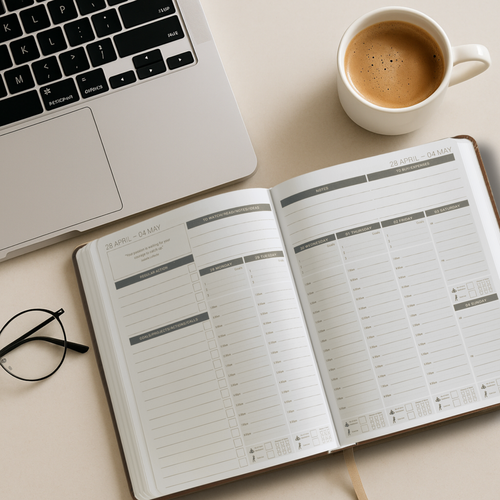
The MY PA Business Planner 2027 has a dedicated monthly marketing and social media planner built into every monthly section. It gives you space to plan your content pillars, your weekly posts, your email schedule and your calls to action for the month. Use it every month as part of your monthly business review.
Section 5: Your Call to Action
Every piece of content you create should have one clear call to action.
Not two. Not three. One.
The most common mistake in small business marketing is creating great content and then not telling people what to do next. You share a brilliant Instagram post about business planning and then... nothing. No link, no prompt, no next step.
Your call to action depends on where you are in your business growth:
If you are building your audience: your call to action is follow, subscribe or join your email list.
If you are launching a product: your call to action is visit the product page, join the waitlist or buy now.
If you are driving ongoing sales: your call to action is shop, read more or book a call.
If you are building trust: your call to action is read this blog post, watch this video or download this resource.
Pick one primary call to action per month and use it consistently across all your content. Changing your call to action every week dilutes its effectiveness.
Section 6: Your Monthly Targets
Without targets you cannot tell whether your marketing is working.
Set simple, measurable targets for each channel each month. Not ambitious targets that make you feel like you are failing. Realistic targets that tell you whether you are moving in the right direction.
Example monthly marketing targets:
Instagram: grow from 2,400 to 2,500 followers
Email list: grow from 800 to 850 subscribers
Website traffic: 1,200 visitors from organic search
Pinterest: 10,000 monthly impressions
Sales from marketing: 15 orders directly attributed to marketing activity
Review these targets at the end of every month as part of your monthly business review. If you are consistently hitting them, raise them. If you are consistently missing them, either the targets are wrong or something in your strategy needs to change.
The One Page Marketing Plan Template
Here is the complete template. Copy it into your planner, a notebook or a document and fill it in now. It should take no more than an hour.
MY ONE PAGE MARKETING PLAN — 2027
My ideal customer:
Who they are, what they want, what is stopping them, where they spend time online.
My one core message:
The one idea I want to own in my customer's mind.
My two primary channels:
1.
2.
My monthly content plan:
Channel 1 — [name]:
Frequency:
Content types:
Ratio (useful vs promotional):
Channel 2 — [name]:
Frequency:
Content types:
Ratio (useful vs promotional):
My primary call to action this month:
My monthly targets:
Channel 1 target:
Channel 2 target:
Email list target:
Sales target:
What I am NOT doing this month:
That last section, what you are not doing, is as important as everything else. Deciding in advance what you are not going to do this month protects your focus and prevents your marketing from expanding to fill all available time.
How to Use This Plan Every Month
The one page marketing plan is not a one-time exercise. It is a monthly discipline.
At the start of every month, spend 20 minutes updating your plan:
Are my targets still right for this month?
Is my call to action changing?
Am I still on the right channels?
What did I learn from last month that should change my approach?
Then use it every week when you plan your content. Your weekly content decisions should flow directly from your monthly plan. If a piece of content does not serve your core message, reach your ideal customer or support your call to action, ask whether you should be creating it at all.
For help connecting your marketing plan to your weekly planning habit read our guide on how to do a weekly review as a business owner.
And if you want to connect your marketing plan to your broader business goals read our guide on how to set business goals for 2027 to make sure your marketing is serving your growth targets.
The Most Important Thing About Your Marketing Plan
The best marketing plan in the world will not work if you do not execute it consistently.
Consistency beats creativity. Showing up every week with useful, relevant content for your ideal customer will build an audience faster than occasional bursts of brilliant content separated by weeks of silence.
The business owners who build the strongest audiences are not the most creative. They are the most consistent. They know who they are talking to, they have one clear message and they show up for their audience every single week.
A one page marketing plan gives you the clarity to do that. It tells you what you are doing, why you are doing it and how you will know if it is working.
Now go and write yours.
Get the MY PA Business Planner 2027 here and use the built-in monthly marketing planner to put your one page plan into action every month.
Also Read
Start your business without guessing
The Business Starter Kit gives you the plan, the pricing, and one place to run it, so you always know what to do next.
- Clear plan, step by step from idea to launch.
- Price for profit, know what to charge and what you will make.
- One Business HQ, run your entire business from one place from day one.
Start free, then choose the next step when you are ready.