Most small business owners have a complicated relationship with their finances.
They know the numbers matter. They know they should be tracking them. But between running the business, serving clients, doing the marketing and everything else, the finances get pushed to the bottom of the pile until tax time — when the panic sets in.
Sound familiar?
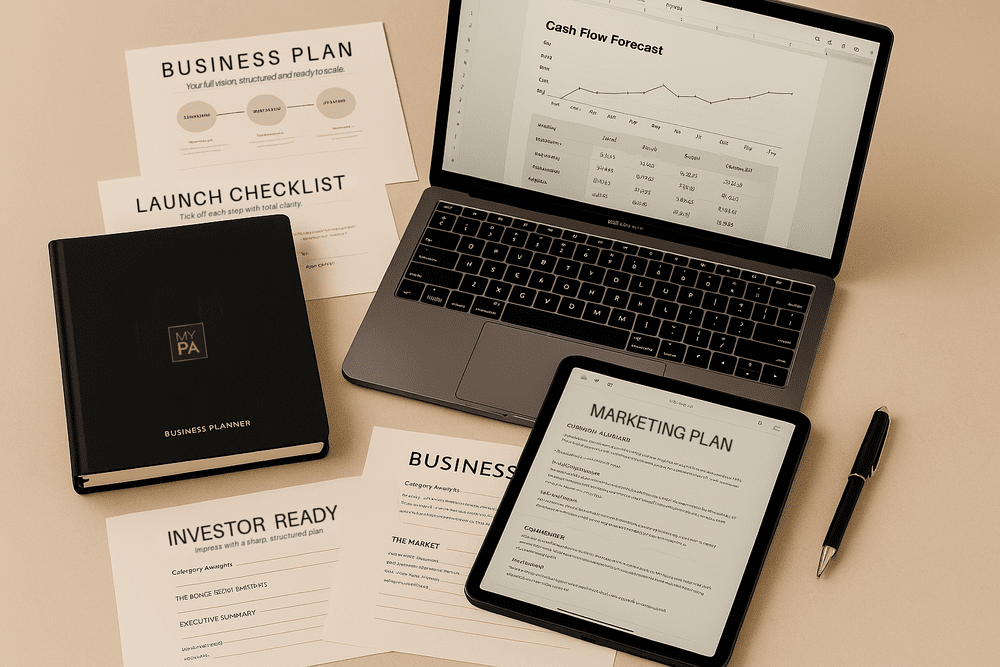
Here's the thing: you don't need complex spreadsheets, accounting software or a finance degree to understand your business finances. You just need a simple monthly habit and the right space to do it in — like the one built into the MY PA 2027 planner If your finances already feel scattered, this guide on how to organise small business finances is a good place to start too.
This is how to track your business finances in your planner — clearly, simply and in a way you'll actually keep up.
Why Monthly Financial Tracking Matters
If you only look at your finances when your accountant asks for them, you're flying blind for most of the year.
Monthly tracking gives you:
Clarity — you know exactly what's coming in and going out, every month.
Early warnings — you spot problems before they become crises. A month where expenses crept up. A month where income dropped. You see it and you respond.
Better decisions — when you know your numbers, you make better choices. Should you hire someone? Can you afford that software? Is that marketing spend paying off? The numbers tell you.
Less stress — nothing causes more anxiety than not knowing where you stand financially. Monthly tracking eliminates that uncertainty.
Step 1: Know Your Three Types of Costs
Before you start tracking, understand what you're tracking.
Direct costs are the costs directly tied to making or delivering your product or service. For a product business, this is the cost of manufacturing or buying stock, packaging and fulfilment, and transaction fees. For a service business, it might be the cost of a freelancer hired for a specific project.
Direct costs only exist when you make a sale. If you sell nothing, your direct costs are zero.
Fixed expenses are the costs you pay every month regardless of how much you earn. Software subscriptions, rent, wages, insurance, loan repayments. These don't change with your revenue.
Variable expenses are costs that change month to month — advertising spend, travel, training, events. They're not fixed but they're not directly tied to each sale either.
Understanding these three categories is the foundation of financial clarity. When you know which category a cost falls into, you know how to manage it.
Step 2: Set Up Your Annual Plan
At the start of the year, spend an hour on your annual financial plan.
Annual Income Plan — how much do you want to earn this year? Break it down by income stream. What is each one expected to generate? How will you achieve those targets? Start by setting clear business goals for the year [LINK: once the 2027 business goals post is published] so your income targets actually connect to what you're working towards.
Annual Expenses Plan — what will it cost to run your business? List every fixed expense, every variable expense and your estimated direct costs. Calculate your total annual expenses. What is your break even point — the minimum income you need just to cover your costs?
This annual plan becomes your benchmark. Every month, you're measuring actual performance against this plan.
Step 3: Use Your Monthly Money Snapshot
At the start of every month, open your Monthly Money Snapshot page and fill in your forecasts:
What do you expect each income stream to generate this month?
What do you expect to spend on direct costs?
What are your fixed expenses this month?
What variable expenses are you planning?
Writing your forecast before the month begins is important. It makes you intentional about your finances rather than just reactive. You're not just recording what happened — you're deciding what you want to happen.
Step 4: Track Actuals as You Go
Throughout the month, update your actuals as money comes in and goes out.
You don't need to do this every day. Once a week — Friday afternoon for 10 minutes — is enough to keep your numbers current.
At the end of the month, fill in all your actual figures and complete the bottom section:
Sales — target vs actual.
Best seller — what was your top product or service this month?
Profit — forecast vs actual.
Tax pot — how much have you set aside this month, and what's your running total?
Paid myself — what did you actually take from the business?
Step 5: Do Your Month-End Reflection
The numbers tell you what happened. The reflection helps you understand why — and what to do differently. This pairs directly with your monthly business review [LINK: once the monthly review post is published] — the numbers are one half of that picture.
At the end of every month, answer four questions:
Biggest win — what went really well financially this month?
Where did money leak? — were there any expenses you hadn't planned for? Any spending that didn't deliver value? This is not about guilt — it's about awareness.
One thing I'm doing differently next month — what one change would improve your financial position?
Money mindset — what belief are you choosing to carry into next month? This might sound fluffy but your relationship with money affects every financial decision you make. A positive, intentional money mindset is worth cultivating.
The Numbers That Matter Most
If you're just starting out with financial tracking, focus on these five numbers every month:
Total income — what came in?
Total expenses — what went out?
Profit — what's left? (Income minus all costs)
Tax pot — have you set aside enough for your tax bill?
Paid myself — are you actually rewarding yourself for your work?
Everything else is detail. Get these five right and you'll have a clearer picture of your business finances than most small business owners ever achieve.
A Note on Tax
One thing most business owners learn the hard way: set money aside for tax every single month.
A good rule of thumb is 20-25% of your profit. Put it in a separate account and don't touch it. When your tax bill arrives, the money is there. This cash flow 101 guide covers the same principle in more depth if you want the fuller picture.
The Monthly Money Snapshot has a dedicated tax pot field — this month's contribution and your running total. Use it religiously.
You Don't Need to Love Numbers
You don't have to be a numbers person to track your business finances. You just have to be someone who spends 30 minutes at the end of each month on your finances instead of avoiding them.
The clarity you get from knowing your numbers — really knowing them — is one of the most empowering feelings in business. You stop reacting to money and start managing it.
If you haven't set up your planner yet, start here [LINK: once the setup guide post is published] — it only takes a few minutes and every section in this post lives inside it.
Start simple. Stay consistent. The numbers will tell you everything you need to know.
The MY PA 2027 Business Planner includes an Annual Income Plan, Annual Expenses Plan and a Monthly Money Snapshot in every monthly section. Shop now at mypaplanner.com.
Start your business without guessing
The Business Starter Kit gives you the plan, the pricing, and one place to run it, so you always know what to do next.
- Clear plan, step by step from idea to launch.
- Price for profit, know what to charge and what you will make.
- One Business HQ, run your entire business from one place from day one.
Start free, then choose the next step when you are ready.